About 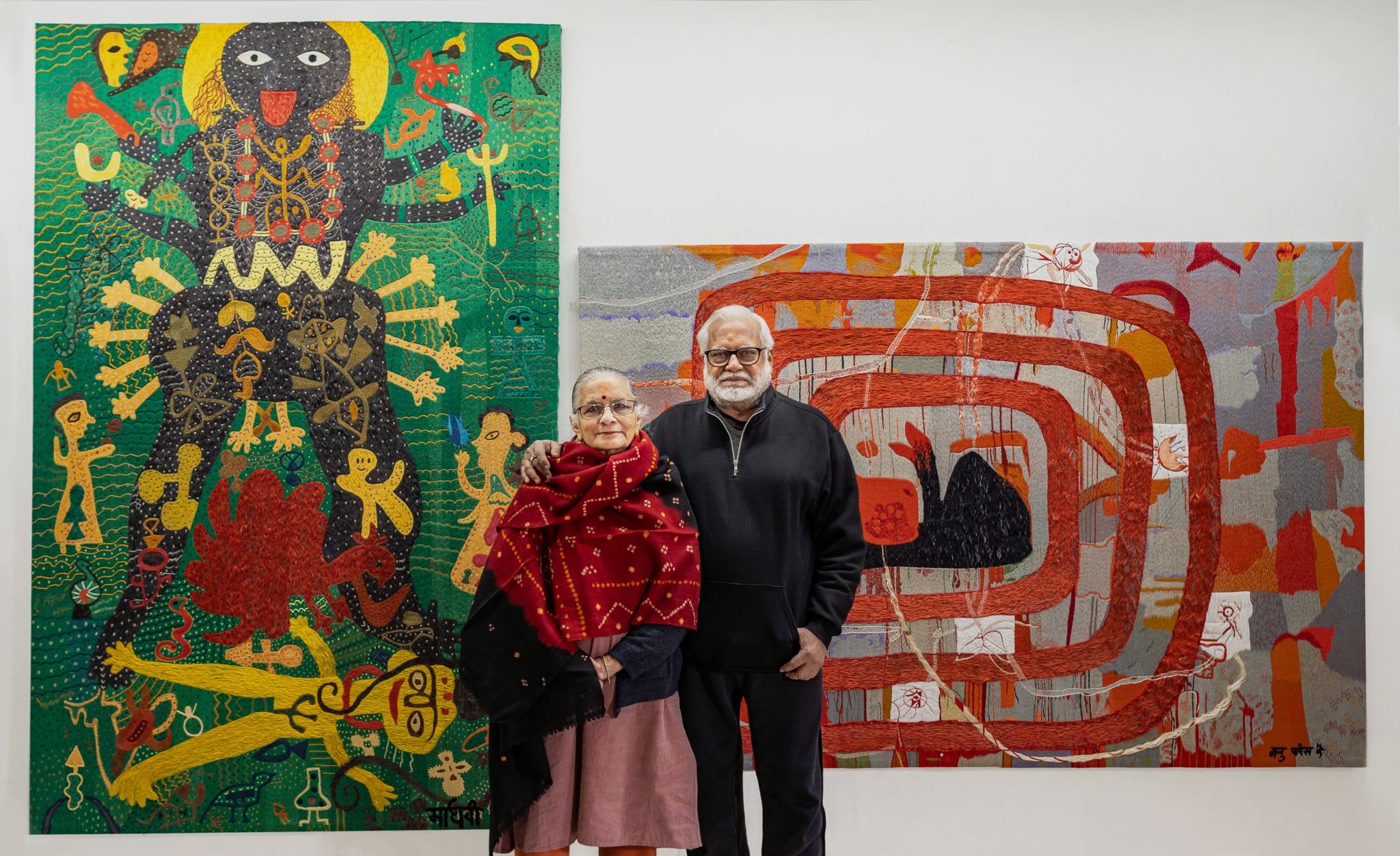
About
About
About



About Dior & the Artists
About
Madhvi Parekh
Madhvi Parekh (b. 1942 in Gujarat, India; lives and works in New Delhi). Madhvi’s traditional representations revolve around her childhood memories, Indian mythology, women’s craft, art and folk legends, all of which are aimed at narrating a story or a life experience. As a self-taught artist, apart from folk motifs and figures, she also uses imaginary, dream-like characters and spiritual abstractions that celebrate the male-female and real-surreal dichotomies.
In 1975, Madhvi won a certificate of merit at the Women’s International Exhibition at the Rashtrapati Bhawan in New Delhi. In 1979, she was awarded the National Award from the Lalit Kala Akademi in New Delhi. She was the subject of Dwitiya, a documentary film produced by the Ministry of External Affairs, Government of India, along with her husband artist Manu Parekh. She has participated in exhibitions around the world, including the Metropolitan Museum of Art, New York (where her work is part of their permanent collection); Frieze, London, Amsterdam, New York, Australia and Hong Kong. In 2017, a retrospective of her work entitled The Curious Seeker was shown at DAG, New Delhi. The exhibition travelled to DAG, Mumbai in 2018 and DAG, New York in 2019.
About
Manu Parekh
Manu Parekh (b. 1939 in Gujarat, India; lives and works in New Delhi), is among India’s best-known contemporary artists. Fascinated by the modernism of Paul Klee and Rabindranath Tagore, through the teachings of S.B Palsikar at the J.J. School of Art, he began experimenting with a form of modernism that engaged with India’s vernacular art forms such as embroidery, which were familiar to him from his childhood in Gujarat. During his work with the Weaver’s Service Centre and the Handicrafts and Handlooms Export Corporation of India, under the guidance of Pupul Jayakar, he renewed his search for language and encountered many vernacular art forms traveling across western, northern, and eastern India. All his works are instinctive and powerful, illustrating his relationship with the tangible and sensual body, the earth and fertility.
Parekh has had many solo and group exhibitions and was awarded the President of India’s Silver Plaque and the All India Fine Arts and Crafts Society Award (New Delhi, 1972); the National Award of the Lalit Kala Akademi (New Delhi, 1982); and the Padma Shree by the Government of India (1992). He was the subject of Dwitiya, a documentary film produced by the Indian Government’s Ministry of External Affairs, along with his wife artist Madhvi Parekh. In 2013, Parekh received an honorary Doctorate in Literature from Rabindra Bharati University, Kolkata in 2013.
About
Maria Grazia Chiuri
Photo credits Laura Sciacovelli
Maria Grazia Chiuri was born in Rome in 1964. Inspired by her mother, a dressmaker, she knew early on that she would follow the same path. She enrolled at the Istituto Europeo di Design in Rome, where she trained in the technical side of fashion while exploring the Italian capital’s cultural heritage. She began her career at Fendi in 1989, where she oversaw handbag design. In 1999, she was appointed head of accessories at Valentino, where she became the brand’s co-creative director alongside Pierpaolo Piccioli from 2008 to 2016. In July 2016, Maria Grazia Chiuri was named Creative Director of Dior women’s collections, becoming the first woman to hold this position.
Following the Dior autumn-winter 2019-2020 haute couture show, she was decorated, on behalf of the President of the Republic, with the insignia of Knight of the National Order of the Legion of Honor, by Secretary of State Marlène Schiappa. She has encouraged a powerful celebration of sorority and inclusivity combined with boundless open-mindedness. True to her committed vision, Maria Grazia Chiuri weaves multiple dialogues with artists and cultures from across the globe in order to preserve and transmit their savoir-faire to younger generations. In parallel, she frequently collaborates with women artists from all cultures – writers, illustrators, choreographers, filmmakers... – celebrating art in all its forms, at the intersection of heritage, dreams and innovation.
Christian Dior
Christian Dior was the designer of dreams. As soon as his House was founded in 1946, and consecrated by the revolution of the New Look, his visionary spirit never ceased to glorify women all over the world. “Fabric is the sole vehicle of our dreams (…). Fashion, in sum, comes from a dream, and dreaming is an escape,” he wrote. Season after season, this exceptional heritage is reinvented by the singular creative passion, force and modernity of the House’s Creative Directors who – from haute couture to perfumes – make the Dior magic live on with audacity, exceptional savoir-faire and its unique beauty of the gesture.
CurationExhibition curator
The Asia Society is a non-profit, non-partisan institution whose purpose is to navigate shared futures for Asia and the world across arts and culture, policy, education, sustainability, business, and technology. With a network of 14 centres in the United States, Europe, Asia and Australia, Asia Society fosters insight, encourages engagement, elevates regional voices, informs and educates new audiences, addresses complex – and where necessary – contentious challenges, engages in creative problem-solving, and helps deliver real solutions for the benefit of all.
An artistic collaboration between Madhvi Parekh, Manu Parekh, Karishma Swali, and the Chanakya School of Craft curated by Asia Society India Centre.
Chanakya School of Craft
Known for creating the extraordinary, Chanakya is inspired by timelessness and rarity. Chanakya’s journey to showcase the everlasting heritage of hand embroidery began in 1986. Helmed by Creative Director Karishma Swali, generations of artisans, art aficionados, preservers and advocates work towards a singular purpose: to ensure that the magic of artisans lives on forever.
Established in 2016, the Chanakya School of Craft is a first of its kind. The non-profit school and foundation are dedicated to craft, culture and a new autonomy for women. The goal for the school is to create a platform of multi-dimensional learning, focused on the arts and crafts while providing equal opportunities to an often-ignored backbone of our communities: women. The holistic curriculum teaches over 300 hand embroidery techniques and is anchored through the voices and lives of historical female figures.
The school has taught over 1000 women to-date, of all ages and socio-economic backgrounds, forming a strong community of skilled, autonomous women. They pursue projects across a wide variety of disciplines, collaborating with artists that include Judy Chicago, Manu Parekh and Madhvi Parekh, fashion houses such as Dior and non-profit organizations, to spread the message of inclusivity and excellence in craft. In the future, they hope to create a global network where design students from all over the world can learn ways in which craft can be seamlessly integrated into art and design.
Asia Society India Center
Inaugurated in 2006, the Asia Society India Centre (ASIC) curates and presents critical perspectives on modern South Asia through diverse programming and building networks of engagement within the subcontinent. As a leading platform for regional and global affairs, ASIC's initiatives span a range of interest areas across arts and culture, business and finance, public policy and geopolitics. Within the arts, ASIC's mandate has been to promote and spotlight visual cultures from South Asia and South Asian diaspora, with a particular focus on modern and contemporary art and art communities. Its programmes include panel discussions, lectures, cultural summits, roundtables, exhibitions and an annual Asia Arts Game Changer Awards gala.
In 2022, the Centre consciously moved towards expanding its cultural mandate and began a long-term series of programmes dedicated to exploring craft and vernacular artistic traditions from the region - their histories, evolution and intersection with other forms of creative practice. With this new direction, ASIC hopes to create a space where audiences can collectively question and learn about the myriad contexts of craft and vernacular art in South Asia.
Curating an exhibition like 'mūḷ māthī / from the roots' represents ASIC's growing cultural vision and interest in the crafts. Curated as a postscript to the original artistic collaboration between Maria Grazia Chiuri, Madhvi Parekh, Manu Parekh, Karishma Swali and the Chanakya School of Craft, the exhibition presents the 22 textile artworks, along with archival material, in an Indian context and for Indian audiences for the first time. The exhibition is an homage to the Parekhs, whose practices have a long-standing relationship with vernacular artistic traditions, an ode to the legacies of embroidery-work and textiles, and a critical reflection on the possibilities of collaborations and patronage in the preservation and sustainability of craft-based artistic work.
Mul Maathi from the roots
An artistic collaboration between Maria Grazia Chiuri (Creative Director of Dior women’s collections), Madhvi Parekh, Manu Parekh, Karishma Swali and the Chanakya School of Craft curated by the Asia Society India Centre with special thanks to the House of Dior, Delphine Arnault (Chair and CEO), Charles Delapalme (Managing Director), Olivier Bialobos (Chief Communication and Image Officer), Rachele Regini, Maria Alicata and Paola Ugolini.